

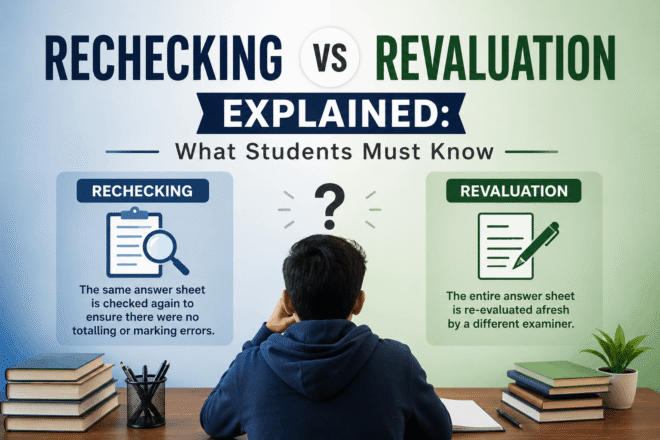
With results being released across India, from CBSE to various state boards, students are rushing to apply for rechecking or revaluation. But many don’t understand the difference. Choosing the wrong option can waste time, money, and even a crucial admission window. Here’s a clear, practical breakdown to help you decide correctly.
Rechecking verifies totaling and unanswered questions.
Revaluation re-evaluates your answers fully.
Rechecking is faster and cheaper; revaluation is deeper but costlier.
Choose based on whether you suspect calculation errors or marking issues.
Rechecking vs Revaluation (Simple):
- Rechecking: Totalling + unchecked answers only
- Revaluation: Full answer sheet re-evaluated
- Best choice:
- Calculation doubt → Rechecking
- Low marks despite good paper → Revaluation
Overview
Every year, lakhs of students across India, whether under CBSE, state boards, or universities, face one common doubt after results:
“My marks don’t match my expectations… what now?”
This is where rechecking and revaluation come in.
These processes can:
- Correct genuine errors
- Improve scores
- Impact on college admissions
- Influence career direction
Latest News
- Digital evaluation is increasing transparency, but human checking errors still happen
- Boards like CBSE now allow photocopies of answer sheets before revaluation
- Universities are facing an overload of revaluation requests, and delays are expected
👉 Real implication:
Students must act fast but wisely
Official Website Guidance
Always verify:
- URL ends with .gov.in / .nic.in
- No spelling errors
- Avoid WhatsApp links claiming “instant revaluation.”
👉 Trusted platforms:
- CBSE official site
- State board portals
- DigiLocker
Rechecking vs Revaluation
What is Rechecking?
- Verification of:
- Totalling errors
- Unchecked answers
- No re-marking
👉 Best for:
“I think marks were added incorrectly.”
What is Revaluation?
- Entire answer sheet re-evaluated
- Answers re-marked
- Marks can increase OR decrease
👉 Best for:
“I wrote well but got low marks.”
Key Differences
| Feature | Rechecking | Revaluation |
|---|---|---|
| Scope | Totalling only | Full evaluation |
| Risk | No decrease | Marks may reduce |
| Cost | Low | Higher |
| Time | Faster | Slower |
| Impact | Limited | Significant |
Smart Decision Advice
Choose rechecking if:
- You’re confident about calculation mistakes
- The difference is small (2–5 marks)
Choose revaluation if:
- Marks are shockingly low
- Theory paper (subjective)
- Strong self-confidence in answers
What To Do Next
If marks are HIGH:
- Apply for top colleges
- Lock admissions early
If marks are AVERAGE:
- Keep backup colleges ready
- Consider entrance exams
If marks are LOW:
- Apply for revaluation
- Explore improvement exams
- Don’t panic, multiple paths exist
Difficulty Analysis
- Objective papers → Easy to Moderate
- Theory-heavy subjects → Moderate to Hard
- Evaluation strictness increased slightly
Trend Insights
- Results are usually released in mid-May
- Revaluation requests are increasing yearly
- Digital copies reduce disputes
Expert Insight
- Cut-offs rising in top colleges
- Even 1–2 marks matter
- Revaluation success rate: ~10–20% improvement in cases
Official Notice Summary
Boards typically state:
- Rechecking = technical verification only
- Revaluation = full reassessment
- Marks after revaluation are final
DISCLAIMER
This content is for informational purposes only. Users should visit the official website for the latest updates.

Education Content Writer | Exam Updates Specialist
Kiran has 3+ years of experience covering university results, sarkari naukri updates, and student guides. He ensures all information is verified from official sources.